

Small home repairs checklist: what to prepare before quoting


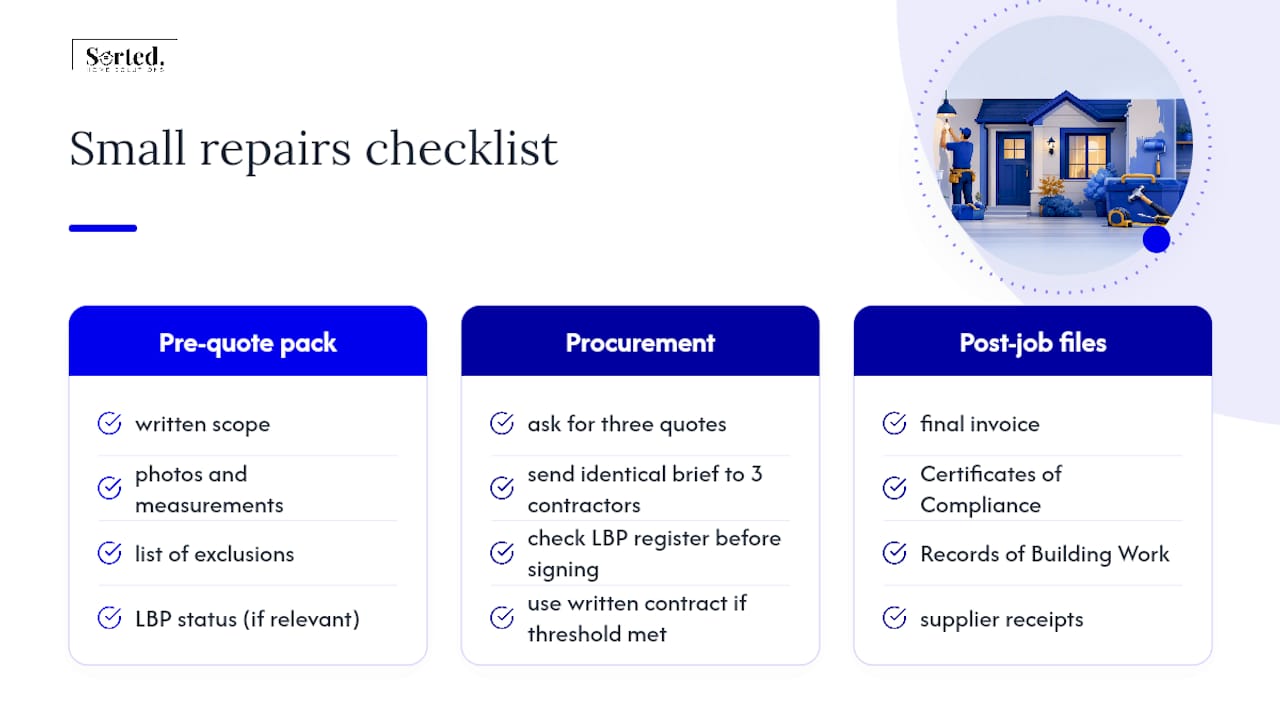
Before you contact a single contractor, six things need to be sorted: a written scope, photos and any plans, a list of fixed exclusions, confirmation the contractor sits on the Licensed Building Practitioner register, proof of insurance and references, and a realistic timeline and budget range. Get these six right and every quote you receive will actually be comparable.
Written scope of work, room by room or task by task
Photos, measurements, or plans of the affected areas
A list of what’s explicitly excluded from the job
Confirmation of LBP registration for any structural or weathertightness work
Proof of insurance and at least two contactable references
A target timeline and a realistic budget range
Pro Tip: Ask every contractor on your shortlist for the MBIE disclosure statement and consumer protection checklist before you sign anything. It costs you nothing to request and tells you a lot about how the contractor operates.
Key Takeaways
Getting comparable quotes for small home repairs depends on sending an identical, detailed brief to at least three licensed, insured contractors and checking every legal box before signing.
Point | Details |
Prepare one identical brief | Write scope, photos, exclusions and materials once, then send it unchanged to every bidder. |
Verify LBP status first | Check the licence register before quoting for any structural or weathertightness work. |
Request the disclosure statement | Ask for MBIE’s checklist even on smaller jobs as a fast way to vet a contractor. |
Compare quotes line by line | Check itemised labour, materials, provisional sums and the variation process on each quote. |
Consider a managed provider | Sorted Home Solutions handles trades, licensing checks, consents and handover under one contract. |
Table of Contents
Small home repairs checklist: what to include in the contractor brief
Licensing, disclosure and consents: the legal checks you must do
How to assess contractors beyond price: communication, references and red flags
Completion checklist: inspections, defects and paperwork to collect at handover
If you prefer a turnkey option: how Sorted Home Solutions can help
Small home repairs checklist: what to include in the contractor brief
A vague brief gets you vague quotes. If three contractors each interpret “fix the bathroom” differently, you’ll end up comparing three unrelated jobs rather than three prices for the same work. The fix is a written brief every bidder receives in identical form.
Structure the brief properly
A workable brief has five parts: a one-line summary of the job, your goals (what “done” looks like), a detailed line-by-line scope, the materials and finishes you want, and any site access or timing constraints. Contractors quoting from the same document will price the same job, not their own guess at it.
Here’s a scope template you can copy directly into an email or document:
Field | What to enter |
Task description | Exact repair or job (e.g. “replace rotted decking boards, rear deck”) |
Expected outcome | The finish standard you want (e.g. “match existing timber, stain to match”) |
Known issues | Any damp, rot, cracking, or suspected asbestos already visible |
Exclusions | What you’re NOT asking them to quote (e.g. “excludes railing replacement”) |
Materials supplier | Who buys materials — you or the contractor |
Attach photos and measurements for every affected area, and label them clearly (“Bathroom, north wall, damp patch, taken 14 Feb”) so each contractor is looking at the same reference points rather than guessing which photo matches which room. A common repair example like water damage shows how much variation exists in scope and cost depending on how far the damage has spread, which is exactly why photos matter more than a written description alone.

Some small jobs aren’t actually small once you look closer. Anything touching a home’s structural integrity or weathertightness counts as restricted building work, and by law it must be carried out or supervised by a Licensed Building Practitioner. That includes many jobs homeowners assume are cosmetic, like re-cladding a section of wall or altering a load-bearing element during a kitchen update. Older homes throw up these issues more often. If your property has problems typical of older housing stock, flag it in the brief so bidders price for what they’ll likely find, not just what’s visible.
How to get comparable quotes: step by step
Getting genuinely comparable quotes is a process, not a request. Follow it in order and you’ll avoid the most common trap: three quotes that can’t actually be lined up against each other.
Send the identical brief, with photos, measurements, and any plans, to at least three shortlisted contractors.
Request a written quote that itemises labour and materials separately, marks any provisional sums, and explains how variations get priced and approved.
Arrange an on-site visit if the job needs one, and ask each contractor to note any assumed exclusions in writing before they finalise their number.
When emailing your brief, attach:
The written scope document
Labelled photos and measurements
Any existing plans or council documents
Your target timeline
Consumer guidance consistently points homeowners toward comparing quotes on identical scope rather than shopping on price alone, and Consumer NZ’s renovation guide backs this up directly.
What a professional quote should include, line by line
A proper quote isn’t a single number. It’s a document you should be able to check against your brief item by item. Look for itemised labour and materials, unit rates where the job allows it, clearly marked provisional or prime-cost sums, fixed costs stated separately, explicit exclusions, GST treatment, and a payment schedule tied to project milestones.
Variations matter just as much as the base quote. Ask how a variation gets priced, who needs to approve it, and whether you’ll get written confirmation before extra work starts or extra cost gets added.
Watch for these red flags:
A single lump-sum figure with no breakdown
No start or completion dates
No variation clause at all
A deposit that’s unusually low (a sign of cash-flow risk) or unusually high (a sign you’re funding their next job)
Vague GST treatment or no mention of GST
Run every quote through this line-check before you compare prices side by side.
Licensing, disclosure and consents: the legal checks you must do
This is where corners get cut, and where the cost of cutting them shows up years later. Restricted building work, anything touching structure or weathertightness, must be carried out or supervised by an LBP. Check the licence class on the public register before you sign anything, not after.
A contractor working on structural or weathertightness elements without holding or supervising via a current LBP licence is operating outside the legally required standard, and any resulting compliance issue becomes your problem to fix, not theirs.
Under MBIE guidance, contractors must provide a disclosure statement and consumer protection checklist on request, and for work valued above a certain monetary threshold, written contract documentation becomes mandatory, not optional.
Confirm who’s responsible for lodging building consents and council sign-off
Request Certificates of Compliance or Records of Building Work for relevant trades
Ask for proof of public liability and contract works insurance before work starts
Check licence class matches the actual work being done, not just “a licence”
How to assess contractors beyond price: communication, references and red flags
Price tells you almost nothing about whether a contractor will actually turn up, communicate, and finish the job to standard. NZ Certified Builders points to clearer signals: fast, clear responses to your questions, a written process for handling variations, real references, a portfolio of finished work, and trade qualifications or association membership.
Red flags run the other way: reluctance to provide the disclosure statement, no written quote at all, requests for a large upfront payment, a timeline that keeps shifting, or hesitation confirming their licence class when you ask directly.
Pro Tip: When calling references, ask what happened when something went wrong, not just whether the finished job looked good. Every project hits a snag; how it got handled tells you more than the final photos ever will.
Completion checklist: inspections, defects and paperwork to collect at handover
Don’t sign off on completion until you’ve physically checked the finished work against your original brief, line by line. Write up a defects list for anything that doesn’t match, agree a remediation timeline with the contractor, and only sign off once you’re satisfied it’s resolved.
Inspect all completed items against the original scope document
Create a written, dated defects list if anything falls short
Agree a remediation timeline in writing before final payment
Collect the final invoice, any Certificates of Compliance, and Records of Building Work
Keep every document: warranties, supplier receipts, manufacturer guarantees, and compliance certificates from electricians and plumbers. These matter again at resale, for insurance claims, and if a defect turns up after the defect liability period starts running.
Why a managed full-service contractor suits these jobs
One point of contact means one party accountable for consents, compliance, and the trades doing the actual work. That single accountability is what saves homeowners the most time and stress on small repair projects, far more than chasing the cheapest hourly rate ever will.
If you prefer a turnkey option: how Sorted Home Solutions can help
Running this checklist yourself means chasing three tradies for three quotes, checking three licences, and being the one who spots a missing disclosure statement. Sorted Home Solutions removes that admin load: one team manages every trade on the job, verifies licensing and insurance before work starts, handles consent paperwork, and hands you an itemised quote you can actually compare against what you asked for.

That single point of contact carries through to handover too. Instead of juggling separate certificates from separate trades, you get one coordinated sign-off process with the documentation collected for you. If a small repair has quietly grown into something bigger, or you’re weighing up whether to hire a full-service team versus coordinating specialists yourself, check the pricing and package details and request a quote to see where your project sits.
Frequently asked questions
What should be on a small home repairs checklist before I contact a contractor? Prepare a written scope, photos and measurements, a list of exclusions, confirmation of LBP status where relevant, proof of insurance and references, and a realistic timeline and budget.
Do I need three quotes for a small repair job? Yes, ideally. Sending an identical brief to at least three contractors is the only reliable way to compare pricing, since a single quote gives you no benchmark for whether it’s reasonable.
When is a written contract legally required? Under MBIE guidance, written contract documentation becomes mandatory once building work reaches the regulatory threshold, though a written contract is sensible well below that threshold too.
Who checks whether a contractor is licensed? You do, before signing anything. The LBP register lets you confirm licence class and current status for any work touching structure or weathertightness.
What documents should I keep after the job is finished? Keep the final invoice, Certificates of Compliance, Records of Building Work, supplier receipts, and any manufacturer warranties, in case a defect appears or you sell the property later.
This article is general information, not a substitute for advice from a qualified lawyer. Consult a qualified legal professional about your own circumstances before acting on anything here.
Sources
Recommended
Comments