

Renovation insurance NZ: what to check before you hire


In this article, “renovation insurance” means making sure your renovation is set up properly, not shopping for a policy. It’s about the consents, the tradespeople, the records, and the insurance conversations that stop a kitchen or bathroom job from turning into a compliance or claims headache. Before you sign anything, confirm three things: does the work need a building consent, can your contractor show you Licensed Building Practitioner (LBP) records of work or Certificates of Work, and who carries insurance risk while the site is open.
Consent check — confirm with your council or the Can I Build It tool whether your project is exempt or needs consent.
LBP and records check — ask which trades are LBPs and insist on records of work for restricted building work.
Insurance check — get proof of public liability and site cover, and confirm who’s responsible if something goes wrong mid-project.
Guidance from Building Performance (MBIE) and Auckland Council sets the rules here. Sortedhomesolutions manages this whole process for Auckland homeowners as part of its full-service renovation model.
Key Takeaways
Getting a renovation right in New Zealand depends on locking in consent status, LBP records, and contractor insurance proof before signing, then holding the sequence together through to CCC.
Point | Details |
Confirm consent status early | Use the Can I Build It tool and your council page before getting quotes, not after. |
Insist on LBP records | Ask for LBP numbers and records of work for any restricted building work in the contract. |
Verify insurance properly | Request certificates of currency and call the insurer directly rather than accepting a verbal assurance. |
Tie payments to inspections | Link payment milestones to passed council inspections, not to a builder’s own progress claims. |
Sorted Home Solutions manages it end to end | Sortedhomesolutions coordinates consents, trades and handover documentation through one point of contact for Auckland renovations. |
Table of Contents
Does your renovation need a building consent?
Most structural changes, plumbing that adds new fixtures, and major room reconfigurations need a building consent. Moving a load-bearing wall, adding a bathroom where there wasn’t one, or reworking your home’s drainage all fall into this category. Some low-risk work is exempt under Schedule 1 of the Building Act, including certain small internal repairs and, under specific conditions, some minor structures.
Exempt does not mean unregulated. Work that skips consent still has to meet the Building Code, and getting it wrong can cause problems at resale or insurance claim time.
Structural alterations, most new plumbing fixtures, and large layout changes usually need consent.
Schedule 1 exemptions cover specific low-risk categories, each with its own conditions and limits.
Exempt work must still comply with the Building Code even without a consent.
Check the Can I Build It tool before you get quotes, and confirm your read against your local council page. Auckland Council’s permit guidance is a useful starting point for Auckland-specific projects.
Pro Tip: Screenshot or save the Can I Build It result before you brief a contractor. It gives you a reference point if a trade later claims work was exempt when it wasn’t.
How long does a building consent take, and what can delay it?
Once your council accepts a complete application, it has 20 working days to issue a decision. That clock only starts once the application is accepted, and a request for further information (RFI) pauses it entirely until you respond. A vague sketch and a missing LBP certificate can turn a supposed three-week wait into two months.
Councils will not accept an application that lacks required minimum documents, including the names of Licensed Building Practitioners for restricted building work. That rejection happens before the clock even starts, which is exactly the surprise that blindsides homeowners expecting a straightforward 20 working day turnaround.
Here’s the sequence that actually plays out on most Auckland renovation sites:
Application lodged with full documentation, including LBP details for restricted work.
Council either accepts it and starts the clock, or issues an RFI and pauses everything.
Building Consent Authority (BCA) inspectors carry out specified inspections at set stages, often tied to when framing, plumbing, or wiring can be closed in.
Once every inspection passes, the council issues the Code Compliance Certificate (CCC), closing the file.
Auckland Council is explicit that a missing a specified inspection during construction is a common operational cause of delays to the CCC. If a wall gets closed in before the framing inspection happens, you may need to open it back up.
This is why payment milestones matter. Tie payments to passed inspections rather than to a builder’s own progress claims, and get inspection dates confirmed in writing rather than left to a verbal “we’ll sort it.” Auckland’s older timber housing stock also brings hidden moisture risk that sequencing decisions can expose or hide, according to local renovation playbooks, so a rushed sequence is rarely a shortcut worth taking.
What insurance and paperwork should you check during the renovation?
Your home and contents insurer needs to know renovations are happening. Most policies require notification of significant work, and some exclude damage linked to renovation activity unless you’ve told the insurer and they’ve agreed to cover it. Call your insurer before the first wall comes down, not after something goes wrong.
On the contractor side, ask for proof of:
Public liability insurance, covering damage or injury caused by the work.
Contract works or site insurance, where the project scale warrants it.
Professional indemnity, if a designer or architect is involved in drawings.
Copies of certificates of currency, showing policy limits and expiry dates, not just a verbal assurance.
Records of work (ROW) and Certificates of Work (COW) from LBPs matter well beyond the consent process itself. They’re the evidence an insurer or a future buyer will ask for if something goes wrong down the track, and without them a claim can stall regardless of how good the workmanship actually was.
If you discover past work on your property that was never consented, a Certificate of Acceptance (CoA) may be the only way to legalise it before you build on top of it, something Building Performance guidance treats as a legal obligation, not an optional extra. Variations during the job (a moved power point, an upgraded tapware spec) should always be priced and approved in writing, because verbal changes are the most common source of dispute once the final invoice lands.
Pro Tip: Ask your contractor to email you certificates of currency directly from their insurer, not a photo of a document. A live email is easier to verify and harder to fake.
Questions to ask a contractor before you sign
Compare quotes on more than price. The right questions expose whether a contractor actually manages consents and insurance properly, or just assumes it’ll work out.
Before you sign:
Who is applying for the building consent, and in whose name?
Which trades on this job are Licensed Building Practitioners, and can I see their LBP numbers?
Can you send me certificates of currency for your public liability and site insurance?
During the works:
Who books council inspections, and how will I be told the dates?
How are variations priced, and do I approve them in writing before work continues?
At completion:
What records of work, COW, and warranties will I receive at handover?
How are defects handled, and for how long after completion?
Treat these as red flags: a contractor who only makes promises verbally, hesitates to name their LBPs, or pushes for large upfront payments not tied to milestones. A good contractor answers these questions without flinching, because they answer them for every client, not just you.
How Sortedhomesolutions manages consents, trades and paperwork
Sortedhomesolutions runs Auckland renovations as a single point of contact across every trade, kitchens, bathrooms, cabinetry, plumbing, electrical, plastering, painting, and flooring, so homeowners aren’t the ones chasing consent status between six different subcontractors.
That single point of contact model directly targets the biggest risk this article has covered: missed inspections and paperwork gaps that stall a CCC or complicate a future insurance claim. Managing consent administration and inspection scheduling in one place, rather than leaving it to whichever trade happens to be onsite that week, cuts the odds of a dropped inspection or a missing LBP certificate.
Consent administration handled as part of the project, not left to the homeowner to chase.
Records of work and warranties provided at handover, not promised and forgotten.
Before-and-after project evidence available for homeowners weighing scope and outcomes.
Real Auckland before-and-after results and a published renovation defects list give homeowners a way to sense check what “done properly” actually looks like before they commit to a contract.
Will renovating affect your home and contents insurance?
Renovating changes the risk profile of your home, and your insurer needs to know. Leaving a roof open during a re-clad, running live plumbing mid-renovation, or having a site accessible to multiple trades all shift the likelihood and severity of a claim compared to a home sitting quietly occupied.

Some insurers require notification for any renovation above a certain scope, others only for structural work; the trigger point varies by provider and policy wording, so read your policy rather than assume. Failing to notify can mean a claim gets declined entirely, even for damage that seems unrelated to the renovation itself, such as a storm that gets into a home with an open wall cavity.
Ask your insurer three direct questions before work starts: does my current policy cover the property during construction, do I need a separate endorsement or temporary extension, and does cover change once the CCC is issued and the work is formally complete? Some insurers treat uncertified renovation work as an ongoing gap in cover even after trades have finished, until the CCC closes the file.
It’s also worth checking whether your contractor’s site insurance and your own home policy overlap or leave a gap between them, particularly around the boundary of “the contractor’s work area” versus “the rest of the house.” A five-minute phone call to your insurer at the quote stage is far cheaper than discovering a coverage gap after a claim.
What happens if you skip consent or insurance checks
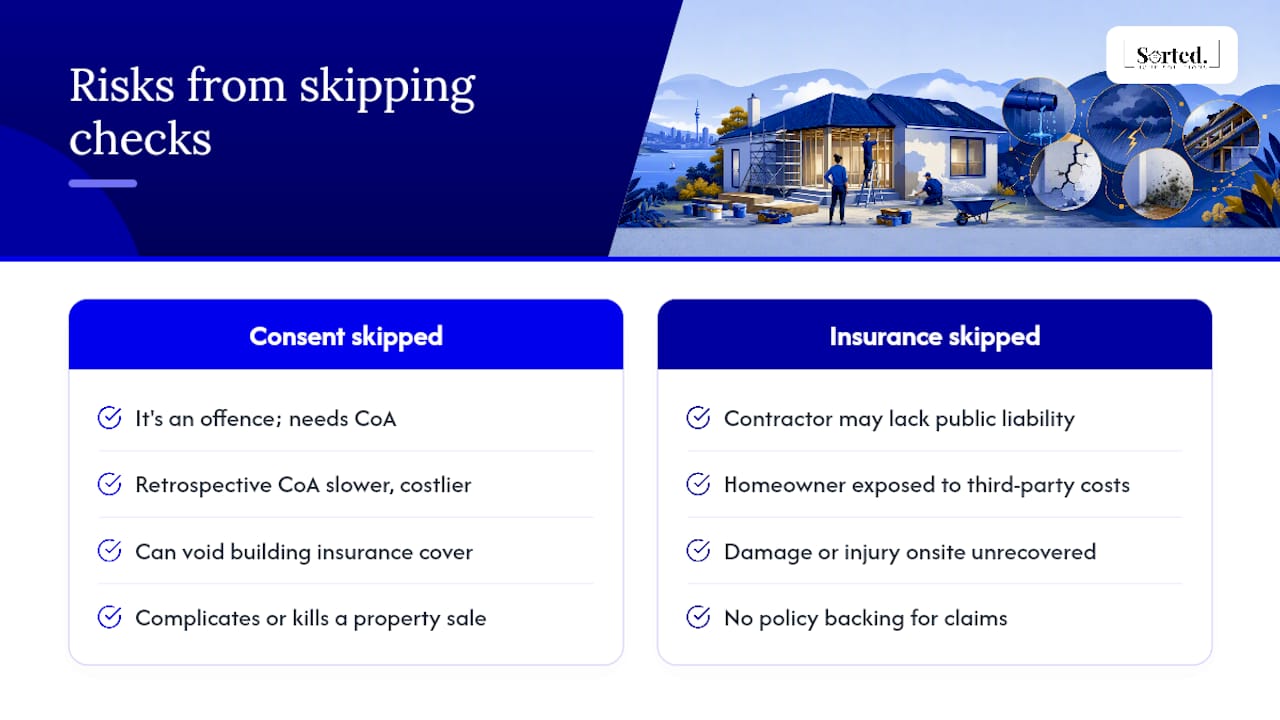
Skipping a required consent is not a minor paperwork shortcut. Building Performance guidance is explicit that starting consent-required work without one is an offence, and it can leave you needing a retrospective Certificate of Acceptance, a slower and often more expensive process than getting consent upfront.
The practical risks stack up. Unconsented structural work can void relevant insurance cover entirely. It can complicate or kill a sale, because buyers’ lawyers routinely ask for CCCs and consent records during due diligence. And it can leave defects hidden behind walls that only surface years later, at a much higher repair cost than if they’d been caught at inspection stage.
Skipping insurance checks carries a quieter but equally real risk. If your contractor has no public liability cover and a tradesperson damages a neighbouring property or someone is injured onsite, you as the homeowner can be left exposed to that cost with no policy standing behind it.
Mitigating both risks comes down to sequencing, not luck: confirm consent status before signing a contract, insist on LBP records as work progresses rather than at the end, and keep your insurer in the loop from day one. If you’ve inherited unconsented work from a previous owner, legalising it through a CoA before you build over it protects you from inheriting someone else’s shortcut.
Why the Licensed Building Practitioner scheme matters
The LBP scheme licenses individual tradespeople across categories like carpentry, plumbing, and design to carry out or supervise restricted building work, the higher-risk work most closely tied to a home’s structural integrity and weathertightness.
For consent purposes, LBP involvement isn’t optional for restricted building work. Building Performance guidance confirms that consent applications must name the LBPs doing that work, and applications missing those details can be rejected before the statutory clock even starts.
Beyond the paperwork, LBP status gives you a real accountability trail. Records of work and Certificates of Work are tied to a specific licensed individual, not a company name that could dissolve and reappear under a different name next year. That record is what an insurer, a council, or a future buyer’s lawyer will ask to see, and “the builder said it was fine” is not an acceptable substitute for it.
Ask for LBP numbers upfront and check them, don’t just take a business card at face value. The scheme exists precisely because unlicensed or unsupervised work on structural and weathertightness elements is where the most expensive renovation failures in New Zealand homes tend to originate.
How do you verify a contractor’s insurance and certificates of currency?
Don’t accept a verbal assurance that “we’re covered.” Ask for the actual certificate of currency, the document an insurer issues showing the policy is active, what it covers, and its expiry date.
Check these details on any certificate you’re handed:
The insured business name matches the entity signing your contract, not a related but different company.
The policy is currently active, not expired or due to lapse mid-project.
The cover type matches the job, public liability for general risk, contract works or site cover for larger structural projects.
The policy limit is adequate for your project’s scale and your home’s value.
For extra confidence, call the insurer or broker named on the certificate directly rather than relying on a document alone, since certificates can be altered or out of date. A contractor confident in their cover will have no issue with you doing this. One who resists or stalls is telling you something important before you’ve signed anything.
Perspective: what most renovation checklists get wrong
Most renovation advice treats consents, LBPs and insurance as three separate boxes to tick. In practice they’re one system: a missing LBP certificate stalls the consent, a stalled consent delays the CCC, and a delayed CCC leaves your insurer questioning whether the work was ever properly finished. Treat them as linked risks, not a checklist to work through in isolation.
The overrated piece of conventional advice is “just ask if they’re insured.” That question invites a yes with no substance behind it. The useful version is “send me the certificate of currency and I’ll call your insurer to confirm it.” That single habit filters out contractors who talk a good game from those who actually operate properly.
What most homeowners should prioritise first isn’t price. It’s sequencing: consent status confirmed, LBPs named, inspections booked before the contract is signed, not chased after the fact. Everything else, including how smoothly your insurance claim goes if something ever does go wrong, follows from getting that sequence right at the start.
Get a project managed properly from quote to CCC
If you’ve read this far, you already know the real risk in a renovation isn’t the trades, it’s the gaps between them: a missed inspection, an unnamed LBP, a certificate nobody actually checked. Sortedhomesolutions removes that gap by running every trade, consent, and inspection through a single point of contact, so nothing falls through the cracks between the plumber finishing and the electrician starting.

Instead of juggling six separate trade contracts and hoping they all show up for their inspections in the right order, you get one fixed-fee contract covering the whole project, with records of work and warranties handed over at completion, not chased down afterwards. This suits homeowners planning a kitchen, bathroom, or whole-home renovation who want the consent and insurance conversations handled as part of the job, not left to them to manage on top of everything else.
See current kitchen and bathroom renovation pricing to get a sense of what a fully project-managed renovation costs before you compare quotes elsewhere.
FAQ: renovation insurance and consents in NZ
Do I need a building consent for a kitchen renovation? Only if it involves structural changes, moving plumbing, or altering drainage. A straightforward like-for-like kitchen swap often doesn’t, but check with Can I Build It or your council first.
How long does a building consent take in New Zealand? Councils have 20 working days once your application is accepted, but a request for further information pauses that clock until you respond, and incomplete applications can be rejected outright.
What insurance should my contractor have for a renovation? At minimum, public liability insurance. Larger structural projects often warrant contract works or site cover too, and any designer involved should carry professional indemnity insurance.
Do I need to tell my home insurer I’m renovating? Yes, in most cases. Notify your insurer before major work starts and confirm whether your policy covers the property during construction or needs a temporary extension.
What is a Certificate of Acceptance and when do I need one? A CoA legalises building work completed without the required consent. You may need one if you discover unconsented past work on your property, or if work has already progressed without consent being obtained.
Sources
Recommended
Comments