

Protect a $15,000–$25,000 NZ Kitchen: Choose HMR Cabinet Materials

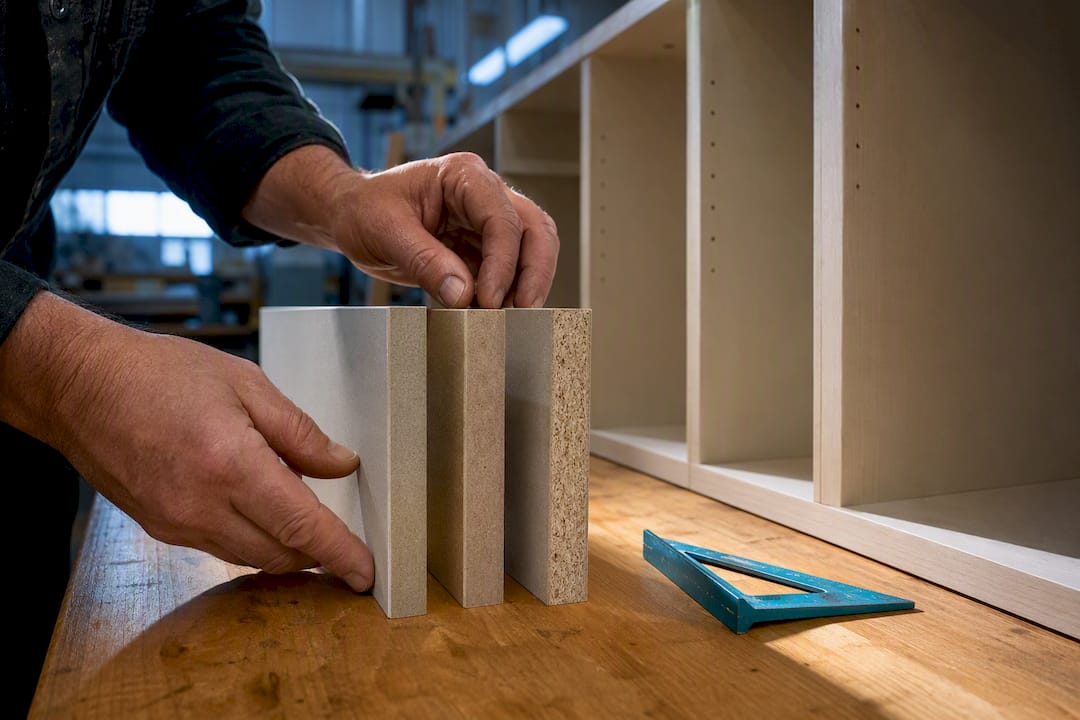
For most New Zealand kitchens, the sensible default is a moisture-resistant melamine (Melteca or Laminex) faced board or a quality plywood carcass, with sealed edges and HMR (high moisture resistant) board wherever cabinets sit near a sink, dishwasher or cooktop. Moisture resistance matters more here than in drier climates, because humidity and cooking steam cause cheaper imported boards to swell and delaminate within a few years. Budget renovators can still get good results with HMR melamine; those with more to spend often move to acrylic (Ultraglaze) doors or solid timber for a longer-lasting, premium look.
TL;DR:
Moisture-resistant HMR melamine or plywood is essential for cabinets near sinks, dishwashers, or cooktops to prevent swelling and delamination over time.
Plywood carcasses outperform MDF in high-humidity environments due to better moisture resistance and structural stability, especially in Auckland’s climate.
Standard MDF is unsuitable within splash zones unless upgraded to moisture-resistant grades, and low-density imported boards often swell prematurely in humid conditions.
Acrylic (Ultraglaze) and solid timber offer premium options but come with higher costs and some maintenance considerations like fingerprint visibility or sealing requirements.
Confirm substrate type, edge sealing, and hardware brands in writing before signing a cabinet quote to ensure durability, repairability, and compliance with moisture resistance standards.
Table of Contents
What cabinet materials are used in NZ kitchens?
Every kitchen carcass, door and drawer front in a New Zealand home is built from one of a handful of base materials, each with a different balance of cost, strength and moisture tolerance. Getting this right at the spec stage avoids expensive rework later, particularly in Auckland’s humid summers and older villas with poor ventilation.
Solid timber
Solid timber cabinetry uses native or imported hardwood (oak, American ash, rimu) machined into door frames, panels or full carcasses. It has genuine longevity and a warm, natural look that laminate can’t fully replicate, and scratches or dents can usually be sanded and refinished rather than replaced.
Pros: repairable, ages well, strong resale appeal, unique grain
Cons: expensive, can expand and contract with humidity changes, needs periodic resealing
Best for: feature doors, freestanding pantries, heritage-style renovations
NZ climate notes: timber moves with seasonal humidity swings, so joinery needs proper acclimatisation and sealed finishes before installation, especially in coastal Auckland suburbs
Plywood
Plywood is built from thin veneer layers glued with the grain running in alternating directions, giving it far better dimensional stability than a single sheet of solid board. Quality plywood resists warping and handles moisture better than MDF while maintaining structural strength over time, which is why it has become the preferred carcass material for many NZ cabinetmakers.
Pros: strong screw and hinge holding, resists warping, holds up well in damp under-sink cabinets
Cons: higher cost than MDF, visible edges need banding or lipping to look finished
Best for: carcasses, shelving, and any cabinet box near plumbing
NZ climate notes: standard carcass thickness runs 16 to 18mm, with 9 to 12mm commonly used for drawer bases and cabinet backs
MDF (medium density fibreboard)
MDF is made from compressed wood fibres bonded with resin, producing an ultra-smooth, uniform surface that takes paint far better than timber or plywood grain. It’s the standard choice for painted shaker-style doors because there’s no grain to show through the finish.
Pros: smooth paintable surface, consistent thickness, affordable
Cons: swells and crumbles if it gets wet, heavier than plywood, poor screw retention without pre-drilling
Best for: painted door faces away from splashback zones
NZ climate notes: never specify standard MDF within splash range of a sink or cooktop, insist on moisture-resistant MDF or HMR grade instead
Melamine and Melteca
Melamine board is particleboard or MDF wrapped in a melamine resin laminate, fused under heat and pressure so the surface resists scratches, stains and everyday knocks. Melteca is the brand name most Kiwi cabinetmakers reach for, and along with Laminex it’s commonly specified in Auckland for durability, sealed-edge performance and a wide range of finishes.
Pros: wide colour and texture range, wipeable surface, budget-friendly relative to timber or acrylic
Cons: chips at exposed edges if banding fails, lower-grade boards can be prone to moisture damage
Best for: full kitchen fitouts on a moderate budget, rental and investment properties
NZ climate notes: always specify HMR-grade substrate under the melamine face, not just a moisture-resistant surface layer
Laminate (Laminex)
Laminate sheets are a thin, high-pressure decorative layer bonded to a substrate, giving you the same durability logic as melamine but usually with a broader range of textures, including convincing timber-look finishes. Laminex is the household name in New Zealand, and it turns up in kitchens, benchtops and splashbacks alike.
Pros: highly durable surface, good scratch and stain resistance, extensive finish catalogue
Cons: substrate underneath still needs to be HMR to genuinely resist moisture, edges are the weak point if not sealed properly
Best for: benchtops, splashback-adjacent cabinetry, high-traffic family kitchens
NZ climate notes: insights from Auckland fitout suppliers note that Melteca and Laminex are chosen partly because local stock and colour-matching make future repairs far easier than with imported systems
Acrylic (Ultraglaze)
Acrylic panels are an MDF core with a thick acrylic surface bonded on, delivering a glass-like gloss that’s genuinely UV stable and fingerprint resistant rather than just marketed that way. Ultraglaze is the recognised NZ brand for this finish, and some acrylic panels come with performance warranties of up to 10 years when installed by an accredited supplier.
Pros: high-end gloss look, resists yellowing and fading, easy to wipe clean
Cons: premium price point, shows fingerprints more than matte finishes despite resistance claims, scratches are harder to spot-repair than laminate
Best for: statement kitchens, north-facing rooms with direct sun exposure
NZ climate notes: sun exposure through large Auckland windows is where UV-stable acrylic earns its keep over standard laminate
Timber veneer
Veneer bonds a thin sheet of real timber onto an MDF or plywood substrate, giving genuine wood grain at a fraction of solid timber’s cost and weight.
Pros: authentic timber appearance, lighter than solid wood, more budget-friendly
Cons: thin surface layer can’t be sanded and refinished repeatedly like solid timber, vulnerable to water at joins
Best for: feature end panels, island benchtops, accent doors
NZ climate notes: seal every edge and joint, since the substrate beneath the veneer is only as moisture-resistant as the board you specified
Thermoform (thermofoil)
Thermoform doors are made by vacuum-wrapping a PVC foil over a shaped MDF profile, which is how you get moulded, seamless shaker-style doors without visible joins.
Pros: no visible seams, affordable, good range of colours and profiles
Cons: foil can peel or bubble near heat sources like ovens, harder to repair than laminate once damaged
Best for: budget cabinetry away from heat-generating appliances
NZ climate notes: avoid thermoform directly beside ovens or in kitchens with poor ventilation, as heat cycling accelerates foil failure
Stainless steel
Stainless steel cabinetry and benchtops are the commercial-kitchen standard adapted for residential use, chosen for hygiene and heat tolerance rather than warmth of look.
Pros: fully waterproof, heat resistant, easy to sanitise, no moisture concerns whatsoever
Cons: shows fingerprints and scratches, cold industrial aesthetic doesn’t suit every home, higher cost for full runs
Best for: butler’s pantries, outdoor kitchens, statement splashbacks
NZ climate notes: the only material on this list where humidity is a non-issue, useful for splashback zones prone to constant splash and steam
Pro Tip: Ask your supplier to confirm the E0 or E1 formaldehyde emission rating on any MDF or particleboard product. E0 is the lower-emission standard and worth insisting on for family kitchens, particularly if anyone in the household has respiratory sensitivities.
Which cabinet material suits your kitchen situation?
Material choice always comes down to a trade-off between upfront cost, how long the cabinetry needs to last, and how much upkeep you’re willing to do. The right answer changes depending on your budget, your household, and where in New Zealand you live.
Tight budget, full kitchen fitout. HMR melamine (Melteca) carcasses with a standard laminate door face give you durability at the lowest realistic cost, and flat-pack plywood systems are a genuine value option when HMR board and sealed edges are specified. Trade-off: fewer finish choices at the very bottom of the price range.
Busy family kitchen with kids. Melteca or Laminex faces on plywood or HMR carcasses handle daily knocks and wipe clean easily, while matte finishes hide fingerprints better than gloss acrylic. Trade-off: matte surfaces show scuffs slightly faster than gloss, but they’re far easier to touch up.
Coastal or high-humidity home. Insist on HMR board throughout, not just on cabinets near the sink, plus fully sealed edges and stainless steel or acrylic near any splashback. Trade-off: this pushes the spec above the cheapest options, but it prevents the delamination that coastal humidity causes within two to three years on lower-grade boards.
Renovating an older villa with poor ventilation. Plywood carcasses outperform MDF here because of their moisture tolerance, paired with an extractor fan upgrade if the budget allows. Trade-off: plywood costs more per sheet than MDF, but it avoids the swelling that poor airflow accelerates.
Premium finish, willing to spend. Acrylic (Ultraglaze) doors or solid timber panelling on plywood carcasses deliver the high-end look, with warranties up to a decade on accredited acrylic installs. Trade-off: higher upfront cost, and acrylic shows fingerprints more than matte alternatives.
Rental or investment property. Melamine on particleboard or HMR MDF keeps costs down while still standing up to tenant turnover, provided edges are properly banded. Trade-off: shorter expected lifespan than plywood, but the cost saving usually makes sense for a rental’s timeframe.
Cabinetry typically makes up 40 to 50 percent of a kitchen renovation budget in Auckland, with mid-range NZ-made cabinetry commonly landing between $15,000 and $25,000, and premium custom joinery running higher. Where your material choice lands in that range depends less on the base substrate than on the door finish and hardware you pair with it, which is why the cabinet installation cost guide is worth checking against your own scenario before you commit to a spec.
What should you check before signing a cabinet quote?
A quote that lists “melamine cabinetry” without a substrate grade tells you almost nothing about how it will hold up. Before you sign anything, get these details confirmed in writing.
Substrate type and explicit HMR confirmation for any cabinet within splash range of a sink, dishwasher or cooktop
Board thickness for carcasses (look for 16 to 18mm) and for drawer bases and backs (9 to 12mm)
Edge-banding method and material, since sealed edges are what actually stop moisture ingress over the life of the cabinet
Door substrate and finish type (painted MDF, laminate, acrylic) so you know exactly what you’re paying for
Hardware brand for hinges and runners, and whether it’s a common, replaceable brand rather than a proprietary imported system
Whether panels are NZ-made or NZ-sized, and what the warranty period and lead time actually cover
At handover: run a hand along every cut edge to feel for sealed banding, open every drawer and door to check for flush joins, and confirm hinges are correctly mortised rather than just screwed to the surface
Pro Tip: A common long-term repair strategy is standardising on widely available hinge and drawer brands rather than a proprietary imported system, so replacement parts stay easy to source years down the track.
What we’ve learned fitting out Auckland kitchens
On Auckland renovation projects, the material decisions that hold up best over time are rarely the flashiest ones. HMR melamine carcasses paired with a Laminex or Melteca door face turn up again and again in family kitchens because they balance cost, durability and easy colour-matching if a door needs replacing years later.
The recurring problem worth flagging is imported low-density board sold as a like-for-like substitute for HMR ply or melamine. It looks identical on a showroom sample, then swells at the sink cabinet within a couple of humid summers because the edge banding wasn’t factory-sealed or the core density was too low to hold moisture out.
Kitchens near Auckland’s coast or in older, poorly ventilated villas benefit most from insisting on HMR board across the whole carcass run, not just under the sink
Painted MDF doors perform well away from splash zones but should never be specified within range of a cooktop’s steam
Flat-pack plywood systems can be a smart value choice when the flat-pack itself still specifies HMR-grade ply and proper edge sealing
For a sense of how these material choices play out in finished spaces, the kitchen renovation gallery shows completed Auckland projects, and the cabinet installation cost guide breaks down how substrate and finish choices affect the final invoice.
Why moisture resistance beats brand names every time
The conventional advice on cabinet materials spends too much time ranking brands and not enough time on the one variable that actually predicts failure: board density and moisture rating. A Melteca-faced door on a poor-quality core will fail faster than a plain painted MDF door on genuine HMR board, and most homeowners never get told that distinction before they sign.
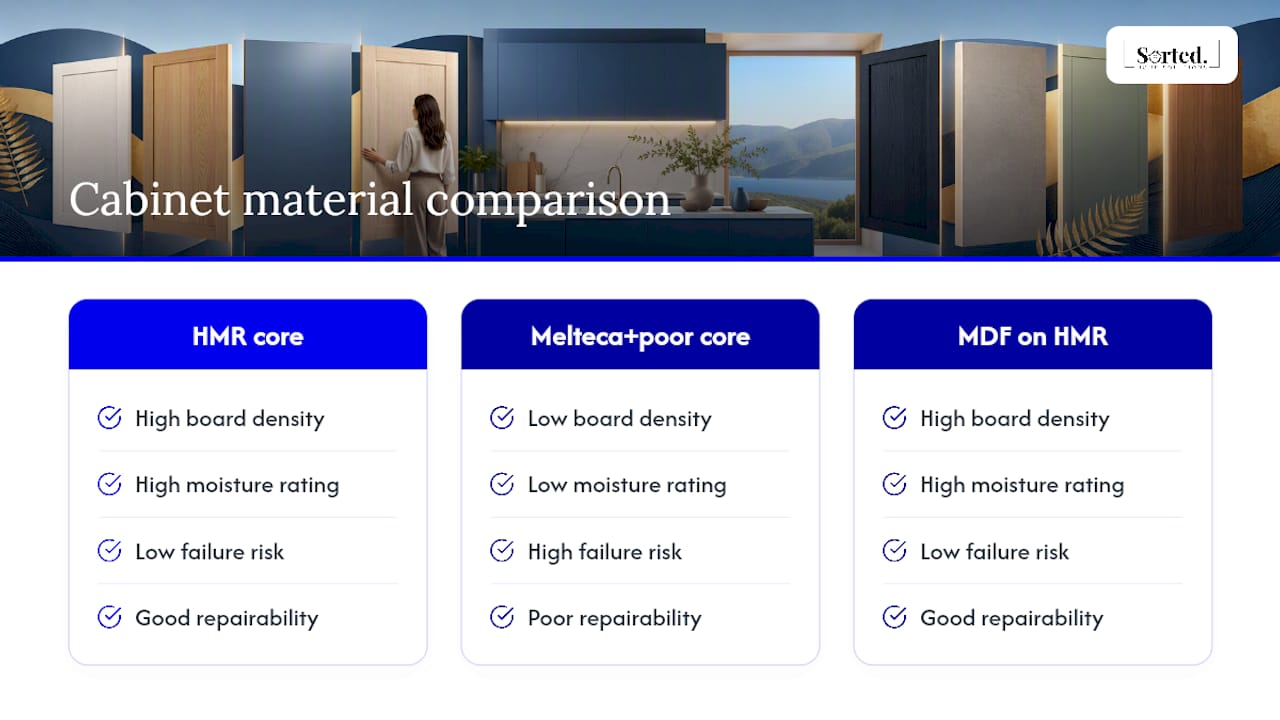
What’s overrated is chasing the glossiest finish first. Acrylic and high-gloss laminate photograph beautifully, but if the substrate behind them isn’t HMR, you’re paying premium prices for a surface that still swells at the first sign of a leaking dishwasher hose.
What should come first is the boring question: what’s underneath the finish, and is it rated for a New Zealand kitchen? Get that answer in writing before you fall in love with a door colour. Repairability matters almost as much, which is why standard hardware and locally stocked finishes like Melteca and Laminex tend to age better in practice than imported proprietary systems that leave you stuck when a hinge fails.
— Rudi
How Sorted Home Solutions manages your cabinet material selection
Some kitchen renovation services run projects as managed projects instead of a string of separate trade quotes, so substrate grade, edge sealing and hardware decisions can be specified correctly the first time rather than discovered after installation.
Some renovation processes start with a design and materials consultation where options like HMR board, Melteca, Laminex and Ultraglaze are reviewed against provided budgets, followed by local fabrication and a handover check to confirm sealed edges, correctly mortised hinges and flush joins before completion. Project scopes may be offered as fixed-price rather than moving quotes, with one point of contact managing cabinetry, plumbing and building consent together. Compare current kitchen and bathroom renovation pricing against your own project, browse the Auckland kitchen gallery for finished examples, and get in touch through our inquiry page to start your quote.
FAQ
What is the most affordable cabinet material?
Melamine on particleboard or standard MDF is the cheapest option, though HMR-grade melamine costs a little more and lasts significantly longer in a kitchen environment.
Which material is better for kitchen cabinets, MDF or plywood?
Plywood generally outperforms MDF for carcasses because of its moisture resistance and stronger screw and hinge holding, while MDF remains the better choice for smooth painted door faces away from splash zones.
What is cabinet material, exactly?
Cabinet material refers to the substrate (the structural board, such as plywood, MDF or particleboard) and the surface finish applied over it, such as melamine, laminate, acrylic or veneer, and both layers determine durability.
Which is better for cabinets, MDF or particle board?
MDF has a denser, smoother surface that takes paint and machining better than standard particleboard, and it generally holds screws more reliably, though neither performs well without an HMR upgrade near moisture sources.
Do I need HMR board for every cabinet in my kitchen?
HMR is most critical within about two metres of a sink, dishwasher or cooktop, though many NZ cabinetmakers now specify it throughout the kitchen for consistent long-term performance.
Recommended
Comments