

Design and build vs architect: which route suits your project?


Design-build suits homeowners who want one contract, one point of contact, and cost certainty early in the process. Architect-led procurement suits homeowners who want maximum design control and independent advice, even if the final price takes longer to lock in.
The gap between the two comes down to when you find out the price and how much say you get over the design after that point.
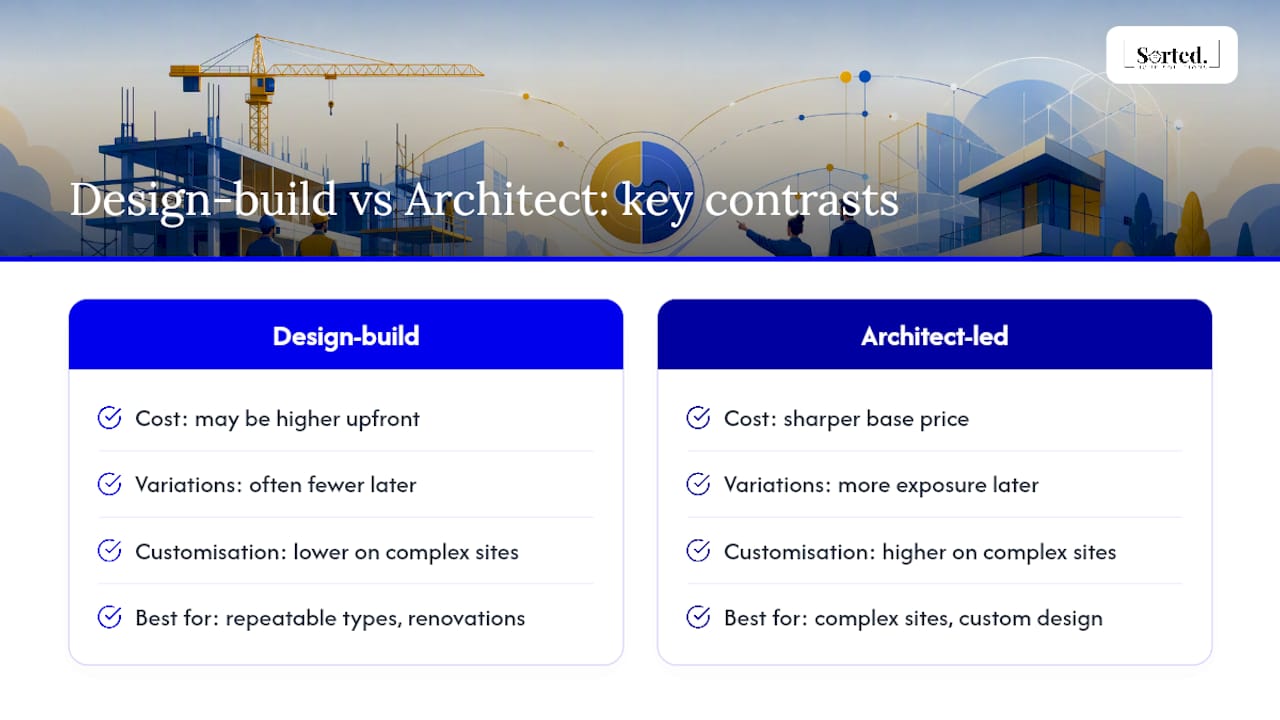
Cost and timeline: design-build typically overlaps design and construction, giving earlier price certainty when the brief is clear from the start, according to Dentons’ analysis of build-only versus design-build contracts. Architect-led work documents the design fully before pricing, which pushes cost certainty later but sharpens the brief.
Design control: architect-led procurement gives you an independent designer advocating for your interests through the build, useful on complex or site-sensitive projects, per NB Architects’ comparison of the two models. Design-build narrows iteration but keeps the builder’s buildability input in the loop from day one.
Neither model is universally better. A straightforward kitchen renovation and a bespoke architectural home sit at opposite ends of the same decision, and your own appetite for managing meetings, variations, and design reviews matters as much as the project type.
Key takeaways
Design-build suits homeowners who want cost certainty and one point of contact, while architect-led procurement suits homeowners who want maximum design control and independent advice through the build.
Point | Details |
Match model to priority | Choose design-build for cost certainty and speed, architect-led for design freedom and independent oversight. |
Consent responsibility stays with you | You remain legally accountable for building consent even when a builder or project manager handles the paperwork. |
Check LBP coverage and consent history | Ask any provider for past consent numbers and confirm Licensed Building Practitioner supervision on restricted building work. |
Bring a quantity surveyor in early | An early cost check during concept design limits scope creep and budget drift under either model. |
Sorted Home Solutions fits the cost-certainty end | Its fixed-fee, single-contract renovation service suits homeowners who want low involvement and a locked-in price rather than a tendered, architect-led process. |
Table of Contents
Design and build vs architect: what design-build actually means
Design-build means one company holds a single contract for both the design and the construction of your project. You’re not juggling a separate architect and builder relationship, you’re dealing with one team that carries responsibility for the whole outcome.
That single-entity structure shifts more design and price risk onto the builder, who prices that risk into the contract, according to Dentons. You’ll usually see one of three commercial variants: fixed price (an agreed lump sum for defined scope), guaranteed maximum price or GMP (a cap with savings potentially shared), or turnkey (the whole project, including finishes and fixtures, delivered ready to use).
For the client, the practical upside is straightforward. You get a single point of contact, earlier input from the people actually swinging hammers on what’s buildable and what it costs, and fewer handoffs where information gets lost. The trade-off is that design iteration tends to be more constrained, particularly once pricing has been agreed, because changes after that point usually mean formal variations rather than free redesign.
Design-build shows up most often in house plans drawn from a builder’s existing plan library, multi-unit developments where repeatable design keeps costs down, and any project where speed matters more than bespoke detailing. Group home builders commonly operate this way, offering efficient, fixed-price processes with faster turnarounds than a fully custom design process. It’s less suited to a difficult, one-off site or a client who wants heavy involvement in every design decision.
What you gain with design-build:
One contract, one point of accountability if something goes wrong
Cost certainty earlier in the process, assuming a clear brief
Faster overall programme through overlapping design and build phases
What you trade off:
Less room for late design changes without a formal variation
Design creativity shaped partly by what’s efficient to build
Less independent advocacy on your behalf during construction
Pro Tip: Ask any design-build team to show you three completed projects with a similar scope to yours, then ask what varied from the original contract price on each one. The answer tells you more than any brochure.
What does architect-led procurement involve?
Architect-led, sometimes called traditional or build-only procurement, separates design from construction into two distinct stages. An architect or architectural designer develops your design first, right through to detailed working drawings, and only then does the project go to tender or a builder gets appointed under a separate contract.
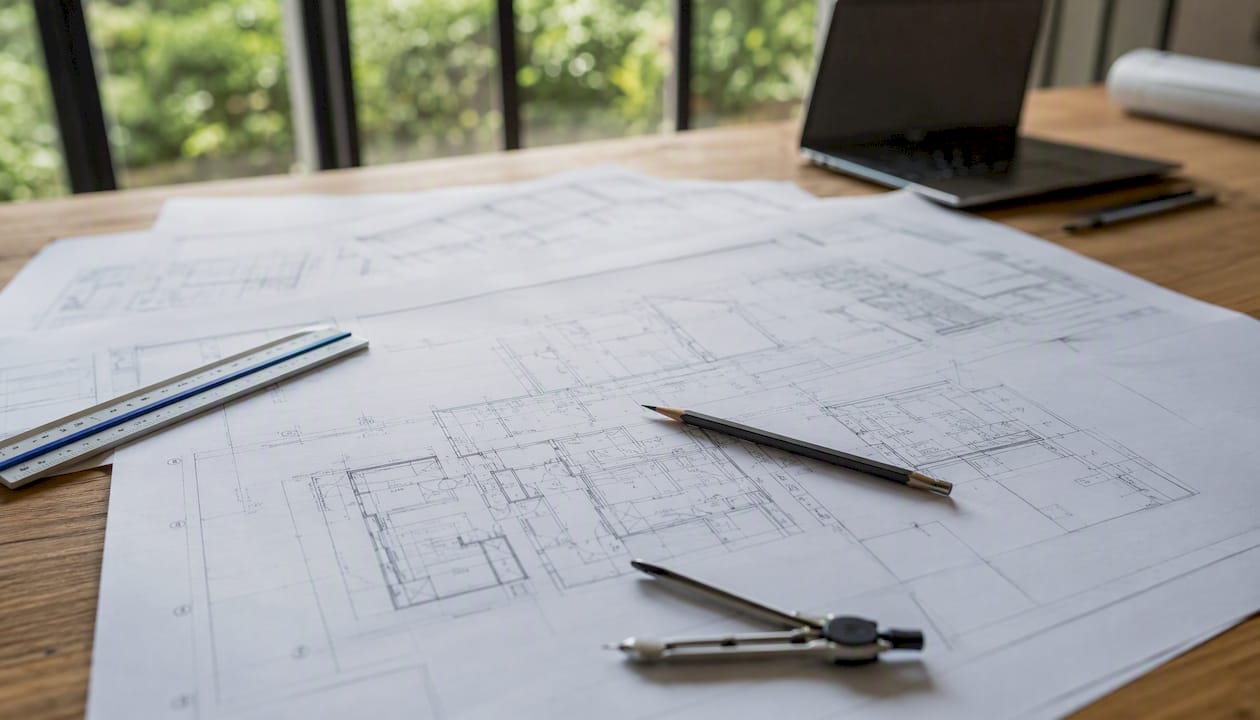
That separation keeps design liability with you and your consultants, while the builder is responsible for workmanship under their own contract, per Dentons. It’s a structure built around independent advice: the architect isn’t the one pricing or building the work, so their advice on materials, layout, and detailing isn’t coloured by what’s cheapest to construct.
The practical implications cut both ways. You get real design freedom and multiple rounds of iteration before anything is locked in, plus the option to run a competitive tender that can sharpen your final builder’s price. But price discovery happens later, and a completed set of drawings still doesn’t guarantee your final number, particularly if the brief shifts after tender or the documentation has gaps.
This route suits complex sites, bespoke homes, heritage considerations, and any project where design quality and site response genuinely matter to the outcome. Architect-designed homes often carry a higher cost per square metre and generally take longer to reach construction start than group builder options, but that premium buys design freedom you won’t get from a plan library.
What you gain with architect-led procurement:
Independent advice through design and construction, not tied to build pricing
Multiple design iterations before you commit to a final layout
Competitive tendering that can push builder pricing down
What you trade off:
Cost certainty arrives later, often only after tender
Longer overall programme before construction even begins
More parties to coordinate, and more room for gaps between drawings and builder pricing
Pro Tip: If you’re going architect-led, ask for a fixed-price or GMP contract with your chosen builder rather than a straight lump-sum tender. It closes some of the tender gap without giving up your independent design advice.
How do the two models compare on the things that matter?
Decision factor | Design-build | Architect-led (traditional) |
Best for (project type) | Repeatable house plans, multi-unit, fast-turnaround renovations | Bespoke homes, complex or site-sensitive projects |
Design freedom / iteration | Moderate, often shaped by buildability | High, multiple rounds before pricing |
Cost certainty | Earlier, especially with fixed price or GMP | Later, typically after tender or builder pricing |
Timeline / speed | Faster, design and build phases overlap | Slower, design must finish before tender |
Risk allocation | Builder carries more design and price risk | Owner carries design risk, builder carries workmanship |
Procurement complexity | Lower, one contract and one contact | Higher, separate design and build contracts |
Building consent management | Usually managed by the design-build team | Can sit with the architect, the builder, or the owner, depending on the agreement |
Quality control / trades coordination | Coordinated internally by one team | Coordinated by the architect or an independent project manager |
Three differences do most of the heavy lifting in this decision. Cost certainty and timeline tend to move together, since overlapping design and build phases under one contract naturally compress the schedule. Risk allocation is the flip side of that speed. When a builder assumes more design risk under design-build, they price it into the contract, which is why design-build can look costlier on paper even as it reduces the chance of expensive variation claims later. And who manages building consent varies enough between contracts that it’s worth confirming explicitly rather than assuming, regardless of which model you pick.
Which model actually suits your project?
Match the project type to the route before you match the route to a provider. A few common scenarios make the fit obvious once you see them laid out.
Quick kitchen or bathroom renovation: design-build, since the scope is well understood and speed matters more than bespoke design exploration.
Bespoke new home on a tricky site: architect-led, because site response and custom detailing benefit from independent design iteration.
Granny flat or minor dwelling: design-build, particularly where the project fits the Schedule 1A exemption criteria and speed and cost certainty are priorities.
Multi-unit development: design-build, where repeatable design and predictable per-unit costs matter more than individual customisation.
Heritage or character home renovation: architect-led, where sensitive design decisions and council heritage requirements need dedicated design attention.
If your priority is low personal involvement and a predictable number you can budget against, design-build fits. If your priority is a highly tailored outcome and you’re comfortable spending more time in design meetings, architect-led procurement gives you that control.
Pro Tip: Write down your top three priorities for the project before you meet anyone, whether that’s cost certainty, design uniqueness, or speed. Whichever route best protects your top priority is usually the right one, even if it compromises on the other two.
Who’s responsible for what under New Zealand building law?
Regardless of which route you choose, you remain the one legally responsible for obtaining building consent and ensuring the work is built to that consent, even when you hand the paperwork to a builder or project manager. You can delegate the administration. You can’t delegate the accountability.
Designers carry their own statutory duty. Under section 14D of the Building Act, anyone preparing plans, specifications, or giving compliance advice must ensure that work, if followed, results in building that meets the Building Code. This applies whether the designer sits inside a design-build company or works independently as your architect, which matters because it means a design-build team’s in-house designer carries the same compliance obligation an external architect would.
Licensed Building Practitioners must carry out or supervise restricted building work, a category covering most structural and weathertightness-critical elements of a home. Small standalone dwellings up to 70 square metres can qualify for the Schedule 1A exemption from needing full building consent, though strict conditions apply, and the Building Act itself sets the broader framework for accountability among owners, designers, builders, and building consent authorities. If you’re renovating rather than building new, it’s worth checking whether your specific project needs a permit before work starts.
Pro Tip: Ask any prospective architect or design-build team for two or three recent building consent numbers from council and check the projects actually closed out with a code compliance certificate. A pattern of unresolved consents is a warning sign worth chasing down.
How do you actually choose between them?
Run both types of provider through the same set of questions in your first meeting, and pay close attention to how specifically they answer.
Ask for a fixed price or GMP quote, not a rough estimate. A vague number at this stage usually means a vague scope, which becomes your problem later.
Ask who signs and manages the building consent. Get this in writing, since assumptions here cause the most disputes down the track.
Ask what’s included in allowances for fixtures, fittings, and finishes. Generous allowances early prevent nasty surprises at selection time.
Ask for the project programme with milestones, not just a start and finish date.
Ask how disputes and variations get handled, and get the change process in writing before you sign anything.
Ask to see two or three comparable past projects, ideally ones you can visit or call the owner about.
Watch for a few red flags as you go. A provider unwilling to show past comparable projects, a brief that stays vague no matter how many times you ask for detail, or a team that can’t confirm LBP coverage for restricted building work should all give you pause. So should hesitation around discussing warranties or dispute processes, since a confident, established provider handles these questions without friction. Resources like Sorted Home Solutions’ guide to choosing a renovation company and a look at specialist versus all-in-one renovation teams can help sharpen these questions before you sit down with anyone.
Where does your budget actually move, and how do you protect it?
Cost movement in both models tends to come from the same handful of sources: incomplete documentation, allowances set too low for the finishes you actually want, site conditions discovered once work starts, and scope creep as small “while we’re at it” additions accumulate.
The two models distribute that risk differently. Design-build pushes more design and price risk onto the builder, who typically prices in a buffer for that risk upfront, which is part of why design-build can look more expensive on paper even as it reduces the odds of expensive variations appearing later. Architect-led procurement keeps that design risk with you, and the tender gap means even a complete set of drawings doesn’t guarantee your final price until a builder actually prices it or agrees a fixed sum.
A few practical habits limit the damage under either model. Bring a quantity surveyor in early, during concept or schematic design, since an early cost check gives you a realistic target and reduces scope creep before it becomes an expensive habit. Push for staged fixed fees rather than one lump payment structure, insist on clear written allowances rather than vague placeholders, and agree upfront on exactly how a variation gets approved and by whom.
Pro Tip: Even inside a design-build contract, a one-off quantity surveyor check at the pricing stage can flag allowances that look tight before you sign, not after.
Managing risk once the contract is signed
Risk management looks different once you’re past the selection stage and into an actual contract, and the two models call for different habits.
Under design-build, your main lever is the contract’s variation clause. Because the builder has already priced in design risk, your job is making sure the fixed price or GMP is genuinely comprehensive before you sign, then holding the line on scope once construction starts. Ask for a written schedule of exactly what’s included and excluded, and treat any verbal “we’ll sort that later” as a flag to get in writing immediately.
Under architect-led procurement, risk sits more with coordination between the architect’s drawings and what the builder actually prices. A staged sign-off process, where the architect reviews and approves drawings at defined milestones before they go to the builder, catches gaps before they become costly variations on site. Independent sign-off on any major scope change, ideally from someone other than the party proposing the change, adds a check that protects both budget and relationships.
Both models benefit from a written risk register covering the handful of items most likely to move: site conditions, consent delays, and material lead times chief among them.
How does communication actually work day to day?
Design-build concentrates decision-making inside one team, which usually means fewer meetings but less independent scrutiny of those decisions. You’ll typically deal with one project lead who coordinates trades, consent, and design questions internally, which speeds up small decisions but means there’s no independent voice checking the builder’s own recommendations.
Architect-led procurement runs through more formal channels. Design decisions get made with your architect before pricing, then construction-phase decisions get routed through the architect as your representative, adding a layer of independent oversight but also adding time to every decision that needs sign-off from multiple parties.
Neither pattern is automatically better for you personally. If you want fast answers and don’t need someone independently checking every recommendation, design-build’s tighter loop suits you. If you want a second set of eyes advocating specifically for your interests through every stage, the architect-led model’s extra step earns its keep.
Who actually checks the work as it happens?
Quality control follows the same split as communication. Design-build teams coordinate trades internally, meaning the same company responsible for design also inspects and signs off on the build. That’s efficient, but it means quality oversight isn’t independent of the party doing the building.
Architect-led projects typically have the architect, or a separately engaged project manager, inspecting work against the drawings and specifications at defined stages. That independence is the entire point of the model. A builder under a build-only contract knows someone outside their own team is checking the work against an agreed standard, which shapes behaviour on site in a way internal-only inspection sometimes doesn’t.
For homeowners weighing this up, it’s worth remembering that Licensed Building Practitioners must supervise restricted building work regardless of which model you choose, which puts a baseline quality mechanism under both. The difference is whether there’s an additional, independent layer on top of that baseline.
A practical view on choosing the right route
Homeowners often ask us which model is “better,” and the honest answer is that the question is usually wrong. The better question is which risks you’re comfortable carrying yourself, because that’s really what you’re choosing between. Design-build isn’t a lesser option for people who can’t afford an architect. It’s a structural choice about who carries design risk and how much of your own time goes into decisions.
One pattern we see often: a homeowner comes to us wanting a full kitchen and bathroom renovation with a clear enough brief, tight enough site constraints, and a firm budget ceiling. They’d looked at engaging an architect separately, then tendering the build. After running the numbers on timeline and the extra coordination involved, they chose a fixed-fee, single-contract approach instead. The result was a locked-in price before demolition started and one point of contact managing plumbers, electricians, and cabinetry installers without the homeowner fielding calls from four different trades.
That’s the scenario where Sorted Home Solutions’s managed, fixed-fee model earns its place. Where cost certainty and low personal involvement matter more than ground-up design exploration, this route consistently delivers a calmer, more predictable renovation experience than juggling separate design and build contracts.
How Sorted Home Solutions makes renovation simpler
If everything above has you leaning toward a single point of contact and a locked-in price, that’s exactly the gap Sorted Home Solutions fills for Auckland homeowners. All trades, one team, managed under a fixed fee, with no separate architect contract, no separate tender, and no juggling five different trade quotes yourself.
Kitchens and bathrooms make up the bulk of what we handle, and our kitchen renovation gallery shows the range of finished work our clients have chosen from, alongside full home renovation examples in our full renovation gallery. Every project runs on tiered package pricing rather than an open-ended hourly build, which means you know your number before we start rather than after. If cost certainty, one contract, and one team managing consent and trades sounds like the fit your project needs, check our kitchen and bathroom pricing and get in touch for a quote.
Frequently asked questions
Is design-build cheaper than hiring an architect separately? Not necessarily. Design-build can look more expensive upfront because the builder prices in the design risk they’re absorbing, but it often reduces costly variations later. Architect-led procurement can produce a sharper base price through competitive tender, but that price arrives later and carries more exposure to variations if documentation gaps exist.
Can I still get a custom design through design-build? Yes, though the level of customisation typically sits below what a dedicated architect can deliver on a complex site. Design-build works well for repeatable house types and straightforward renovations, and less well when a site demands significant custom design testing.
Who is responsible if building consent gets rejected or delayed? You are. Regardless of who manages the paperwork, homeowners remain legally responsible for obtaining consent and ensuring work matches that consent, so it pays to confirm upfront exactly who in your project team is handling lodgement and follow-up with council.
Does a fixed-price design-build contract mean the price can never change? No. Fixed-price and guaranteed maximum price contracts limit variation to genuine scope changes agreed in writing, but they don’t eliminate variations entirely, particularly if site conditions differ from what was assumed at contract signing.
How long does architect-led procurement typically add to a project timeline? It varies by project complexity, but architect-led work generally takes longer to reach construction start than design-build because design must be fully documented before tender or builder pricing begins, rather than overlapping with construction as it does under design-build.
This article is general information, not a substitute for advice from a qualified lawyer. Consult a qualified legal professional about your own circumstances before acting on anything here.
Sources
Recommended
Comments