

What building warranties in NZ actually protect you from


You have legal protection whether or not your builder mentions it. The Building Act 2004 automatically implies warranties into most residential building contracts, giving you a 12-month window for the builder to fix defects and up to 10 years of broader legal cover. Anything beyond that, like the NZCB Halo 10-Year Guarantee or a Master Build Guarantee, is a paid extra, not a replacement for your statutory rights.
Do these things now, before you do anything else:
Get your completion date confirmed in writing (this starts every clock that matters).
Keep every handover document, especially the Record or Certificate of Work and any Code Compliance Certificate.
Report any defect in writing the moment you spot it, with photos and dates attached.
One thing to remember: once you pass the 12-month mark, the burden shifts. You go from “the builder must fix it” to “you must prove it’s actually a defect.” Acting early isn’t optional if you want an easy claim.
Key Takeaways
Statutory implied warranties under the Building Act give every qualifying New Zealand homeowner a 12-month defect repair right and up to 10 years of broader legal protection, automatically and free of charge.
Point | Details |
Two separate clocks | The 12-month defect repair period and the 10-year implied warranty run on different rules, with the burden of proof shifting after 12 months. |
Completion date is critical | Get it confirmed in writing, since it starts both warranty timeframes and often decides disputes. |
Warranties transfer to new owners | Buying a home built within the last 10 years means you inherit whatever’s left of that warranty window. |
Document everything at handover | Insurance certificates, guarantees, Record or Certificate of Work and maintenance info all matter if you ever need to claim. |
Third-party guarantees are optional extras | Schemes like the NZCB Halo Guarantee add cover for insolvency and deposit risk that statutory warranties don’t touch. |
Managed handovers reduce homeowner risk | Sortedhomesolutions provides an organised document pack and maintenance guidance at completion, reducing the paperwork burden if a claim ever arises. |
Table of Contents
What building warranties exist under New Zealand law
New Zealand doesn’t rely on a single “home warranty” certificate the way some countries do. Instead, the Building Act 2004 writes implied warranties directly into most residential building contracts, whether or not the contract mentions them. Sections including 362I set out the specific duties: the work must be done competently, the materials must be suitable and (unless the contract says otherwise) new, and the finished job must comply with the Building Code and the consented plans.
These warranties run on two separate timeframes, which is a frequent source of confusion for homeowners.
The first is the 12-month defect repair period. Within this window, if you report a genuine defect, the contractor is obliged to fix it. There’s no argument required, no proof of fault beyond pointing to the problem. It’s the simplest, cheapest phase of the entire warranty system, which is exactly why so much of this article is about using it properly.
The second is the implied warranty that runs up to 10 years from completion. This is broader and slower. It covers ongoing legal liability for workmanship, materials and code compliance, but after the initial defect repair period you generally need to provide evidence that the defect exists and that it stems from the original work, not later damage or neglect. It’s still a real right. It’s just a harder one to enforce without evidence.
MBIE guidance is unambiguous on one point: these implied warranties cannot be contracted out of. A builder can’t ask you to sign away your 10-year cover, and if a contract tries to, that clause carries no legal weight.
It’s worth being clear about how this differs from the Consumer Guarantees Act, which many homeowners assume covers everything. The Consumer Guarantees Act applies to services tradespeople provide but specifically excludes buildings and building materials. Your house itself, and the work that built it, sits under the Building Act. Trade services adjacent to a build (say, an appliance installation) might touch both regimes, but the structure and workmanship questions always come back to the Building Act’s implied warranties.
Who is protected, and when does the clock start?
The implied warranties apply to most residential building contracts, including work on household units and situations where a builder on-sells a property they’ve built or renovated. Here’s the detail that surprises a lot of people: you’re covered even without a written contract. The warranties are implied by law into qualifying residential work, verbal agreement or not. A written contract just makes proving the terms easier if a dispute ever lands in adjudication or court.
Timing matters more than almost anything else in this system. Both the 12-month and 10-year clocks start from the completion date, sometimes called practical completion. This is why nailing down that date in writing is so important:
Ask for written confirmation of the completion date at handover, not weeks later from memory.
Cross-check that date against your Code Compliance Certificate or Certificate of Work where one applies.
File that confirmation with your other handover paperwork immediately, because you’ll need it if a dispute ever turns on timing.
Buying a home that was built or substantially renovated within the last 10 years? The implied warranties transfer to you as the new owner for whatever remains of that 10-year window. You inherit the protection, not just the previous owner’s memory of it.
Pro Tip: Disputes over defect timing almost always come down to one question: when did the clock actually start? A dated, signed completion confirmation from your builder is worth more than any verbal assurance, because it removes the argument before it starts.
What’s covered, what’s excluded, and where owners get caught out
The implied warranties are specific about what “quality” means in practice. Core cover includes:
Workmanship carried out with reasonable skill and care.
Materials that are suitable for their purpose and, unless your contract states otherwise, new.
Compliance with the Building Code and the plans and specifications you signed off on.
A building that’s actually habitable and fit for its intended use once it’s declared complete.
Where things get messy is exclusions, because this is where most homeowner frustration and most builder pushback actually happens. Warranties generally won’t cover damage from a lack of maintenance on your part, accidental damage caused by a third party, natural disaster events like flooding or earthquake movement, or problems arising from alterations you made after handover that weren’t part of the original work.
The practical difference between a covered defect and an excluded issue often comes down to cause, not appearance. A leaking window flashing installed incorrectly is a defect. The same window leaking three years later because gutters were never cleared and water pooled against the frame looks similar but sits closer to a maintenance failure. Builders and their insurers scrutinise this distinction closely, which is exactly why your own evidence trail matters.
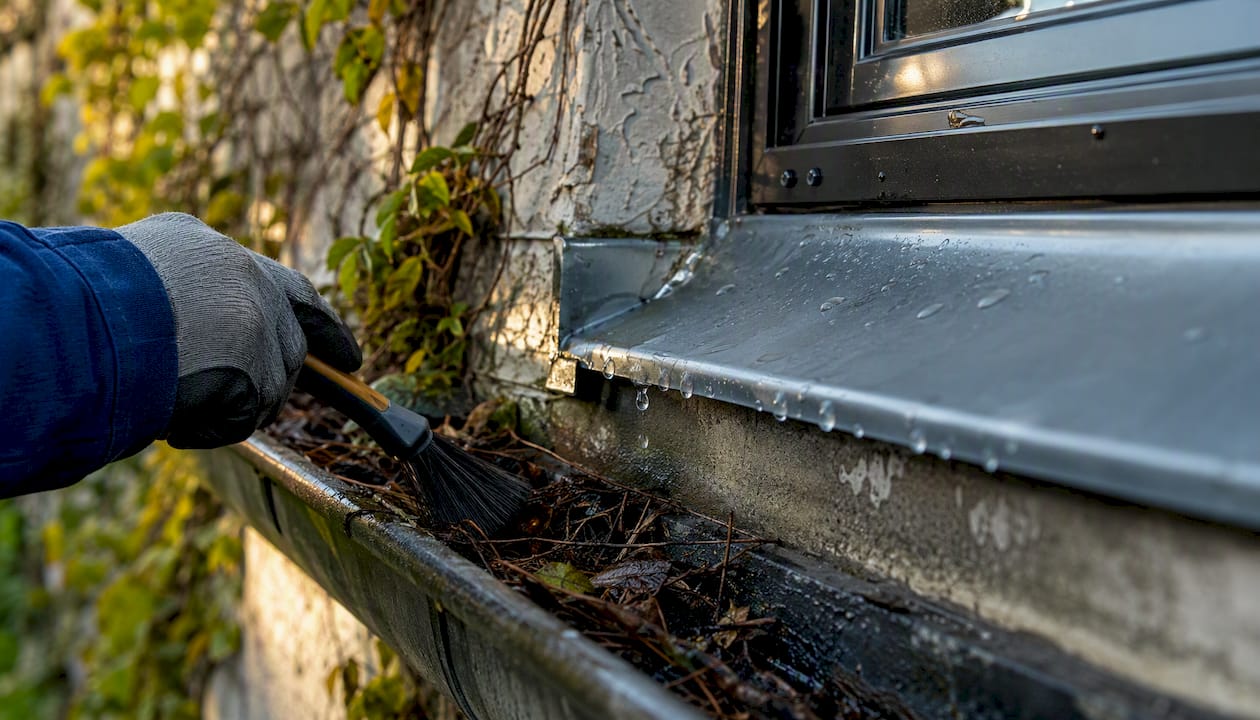
Pro Tip: Set a basic seasonal maintenance routine, clearing gutters, checking seals around wet areas, inspecting exterior cladding twice a year, and log it (even a phone note with dates works). If a warranty dispute ever arises, being able to show you maintained the property properly removes the easiest excuse a builder has for declining a claim.
What documents your builder must hand over at completion
Your legal position is only as strong as your paperwork. At handover, contractors are required to give you a specific set of completion documents, and chasing these down after the fact is far harder than insisting on them at the door.
Ask for, and keep, all of the following:
Insurance certificates covering the work carried out.
Any third-party guarantees or warranties tied to materials or services used.
The Record of Work or Certificate of Work for the project.
A Code Compliance Certificate, where the work required building consent.
Manufacturer warranties for appliances, fixtures and specified building products.
Maintenance information and product care instructions.
Each of these earns its place. The insurance certificate proves cover existed if something goes wrong structurally. The Record or Certificate of Work is often your strongest evidence of what was actually built and when. Maintenance information matters more than people realise, because failing to follow it can void a defect claim entirely.
Store everything digitally and physically, ideally in a single folder you can hand to a lawyer, adjudicator, or future buyer without a scramble.
If anything’s missing at handover, ask in writing immediately, don’t wait until you need it for a claim.
How to make a warranty claim and what happens if the builder won’t fix it
Start simple, and start in writing. The moment you spot a defect, notify your builder in writing with the date, a clear description, and photos. This creates the paper trail that everything else depends on, and it’s the step homeowners skip most often because a phone call feels easier.
Notify the builder in writing and date-stamp the communication.
Give them reasonable time to inspect and respond, most defect notices warrant a written reply within a couple of weeks.
If they agree to fix it, get the scope and timeline in writing before work starts.
If they deny the defect or go silent, escalate in writing again, referencing your original notice and the relevant warranty period.
Keep every email, text, and invoice related to the issue in one file.
If negotiation stalls, you have real options rather than just frustration. Mediation is the least formal and often the fastest route for smaller disputes. Adjudication under the Construction Contracts Act is a faster, cheaper alternative to court and is specifically designed for construction payment and performance disputes. For larger claims or where a builder is genuinely unresponsive, the District Court handles lower-value claims, with the High Court available for more substantial disputes.
MBIE’s own guidance signals where this is heading: recent reform proposals for construction sector liability include moves toward mandatory home warranty arrangements for certain new builds and renovations, aimed at closing gaps that currently leave homeowners exposed when builders can’t or won’t fix a defect.
Whichever path you take, evidence quality decides outcomes. Adjudicators and judges want dated photos, your written notices, invoices for any interim repairs, and, for anything technical, an independent expert report. A defect claim built on memory and frustration rarely gets far. One built on a documented timeline usually does.
Are third-party building guarantees in New Zealand worth paying for?
Statutory implied warranties are automatic and free. Third-party guarantees, like the NZCB Halo 10-Year Guarantee or guarantees offered through Master Builders and Certified Builders schemes, cost money and cover different risks entirely. They typically extend to non-structural defects, deposit protection if a builder goes under before starting work, and completion cover if a builder becomes insolvent mid-project, something your statutory warranty can’t help with at all, since implied warranties don’t automatically protect you if a builder stops trading.
Transferability varies by scheme; some guarantees pass to a new owner for a fee, others don’t transfer at all.
These guarantees add the most value if you’re planning to sell within the guarantee window or you’re working with a smaller builder where insolvency risk feels real.
Premiums are usually paid upfront as a percentage of the build cost, so weigh that against what your statutory cover already gives you before assuming you need the extra layer.
Pro Tip: Read the exclusions before you pay, not after you claim. Some schemes require registration before work starts, and a missed registration deadline can void the guarantee entirely, no matter how much you paid for it.
Your practical checklist: before, during and after handover
Print this or save it, because most disputes trace back to a step someone skipped.
Before work starts: confirm the contract includes agreed completion dates, insurance details and a defined scope, so there’s no ambiguity later.
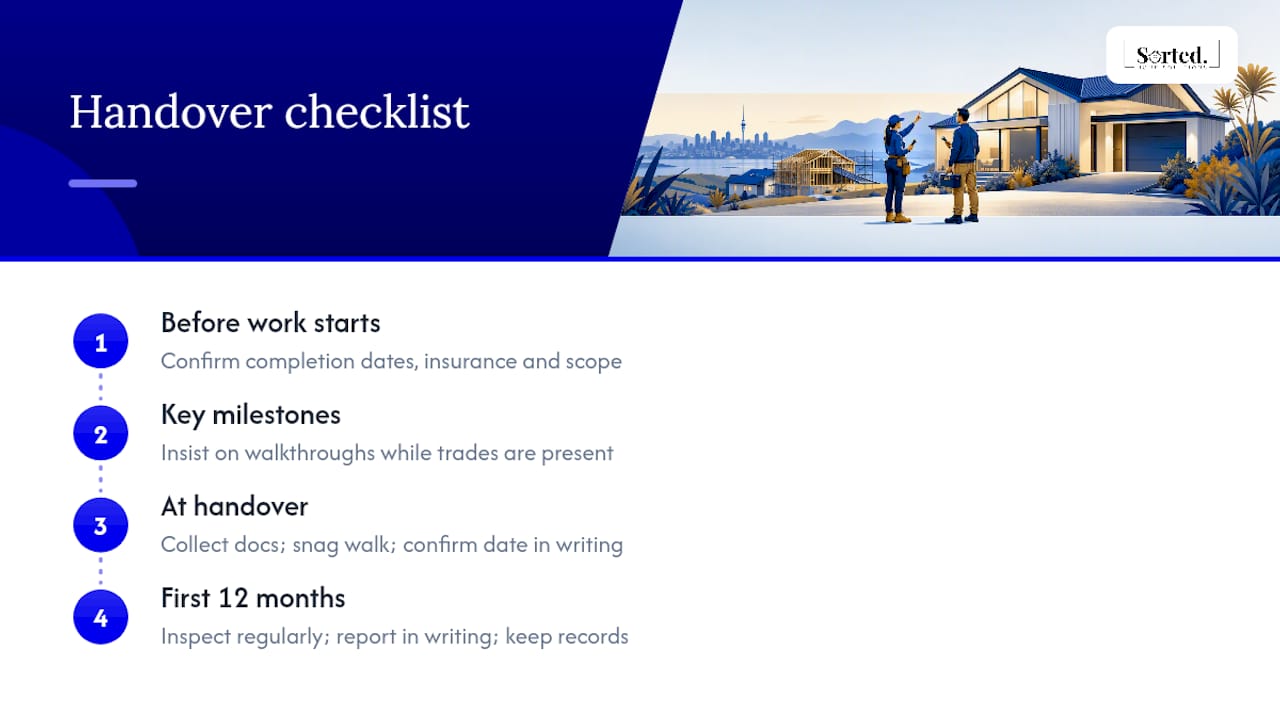
At handover: collect every document listed earlier, walk the property with a written snag list, and get the completion date confirmed in writing on the spot.
First 12 months: inspect regularly, report anything unusual in writing straight away, and keep a running file of every communication and receipt.
Pro Tip: Insist on a walkthrough at key milestones, not just at the end. Catching a defect while the plasterer or plumber is still on site is faster and far less contentious than raising it six months after everyone’s packed up.
What a full-service contractor should hand you at completion
A properly managed handover shouldn’t leave you chasing paperwork. At Sortedhomesolutions, that means an organised document pack covering insurance certificates, relevant guarantees, completion records, and clear maintenance advice, handed over as a matter of course rather than something you have to request.
A single, organised file rather than scattered emails and half-remembered verbal promises.
Practical maintenance guidance tied to the specific materials and systems used in your renovation.
Support understanding which guarantees apply and how to register them, if relevant.
Choosing between a single accountable contractor and multiple specialists matters here, too. When one team manages the whole build, there’s one point of contact for defects, not five subcontractors each pointing at someone else.
Why early documentation beats a good memory every time
The homeowners who struggle most with warranty claims aren’t the ones with worse defects. They’re the ones who reported problems verbally, waited too long, or lost track of when the work actually finished. A dated email and a photo do more legal work than a strong argument delivered a year late. Good documentation isn’t paperwork for its own sake. It’s the difference between a straightforward fix and a drawn-out dispute.
Get your handover documents sorted properly, the first time
Chasing down missing certificates or a forgotten completion date months after your renovation wraps up is a genuinely avoidable headache. Sortedhomesolutions manages that handover process as part of the build itself, giving you one organised document pack covering insurance, guarantees, and maintenance advice, rather than a scattered pile of paperwork from separate trades.

Because one team manages your entire renovation from start to finish, there’s a single point of contact if a defect shows up in year one, not a guessing game over which subcontractor is responsible. If you’re planning a kitchen, bathroom, or full home renovation in Auckland, check current pricing and packages or get in touch through the Sortedhomesolutions site to talk through how your project’s documentation and warranty support would work from day one.
Frequently asked questions
Do I still have building warranties in NZ if I never signed a written contract?
Yes. Implied warranties under the Building Act apply automatically to qualifying residential building work, regardless of whether you signed a formal contract. A written agreement just makes the terms easier to prove if a dispute arises.
What’s the difference between the 12-month defect period and the 10-year warranty?
Within 12 months, a reported defect must simply be fixed, no proof of fault required beyond identifying the problem. After that, the 10-year implied warranty still applies, but you generally need to demonstrate the defect exists and stems from the original work.
Can a builder refuse to honour these warranties by writing an exclusion into the contract?
No. MBIE guidance confirms implied warranties cannot be contracted out of. Any clause attempting to override them carries no legal weight.
Are third-party guarantees like the NZCB Halo Guarantee necessary on top of statutory protection?
Not always, but they cover risks statutory warranties don’t, particularly builder insolvency and deposit loss. They’re worth considering if you’re using a smaller builder or plan to sell within the guarantee period.
What should I do first if I find a defect after moving in?
Notify your builder in writing immediately, with photos and a clear description, and keep a copy of every communication that follows. Early, documented reporting is the single biggest factor in how smoothly a claim resolves.
This article is general information, not a substitute for advice from a qualified lawyer. Consult a qualified legal professional about your own circumstances before acting on anything here.
Sources
Recommended
Comments